
Guide
What Is the Hardest Game in History?
9 min read
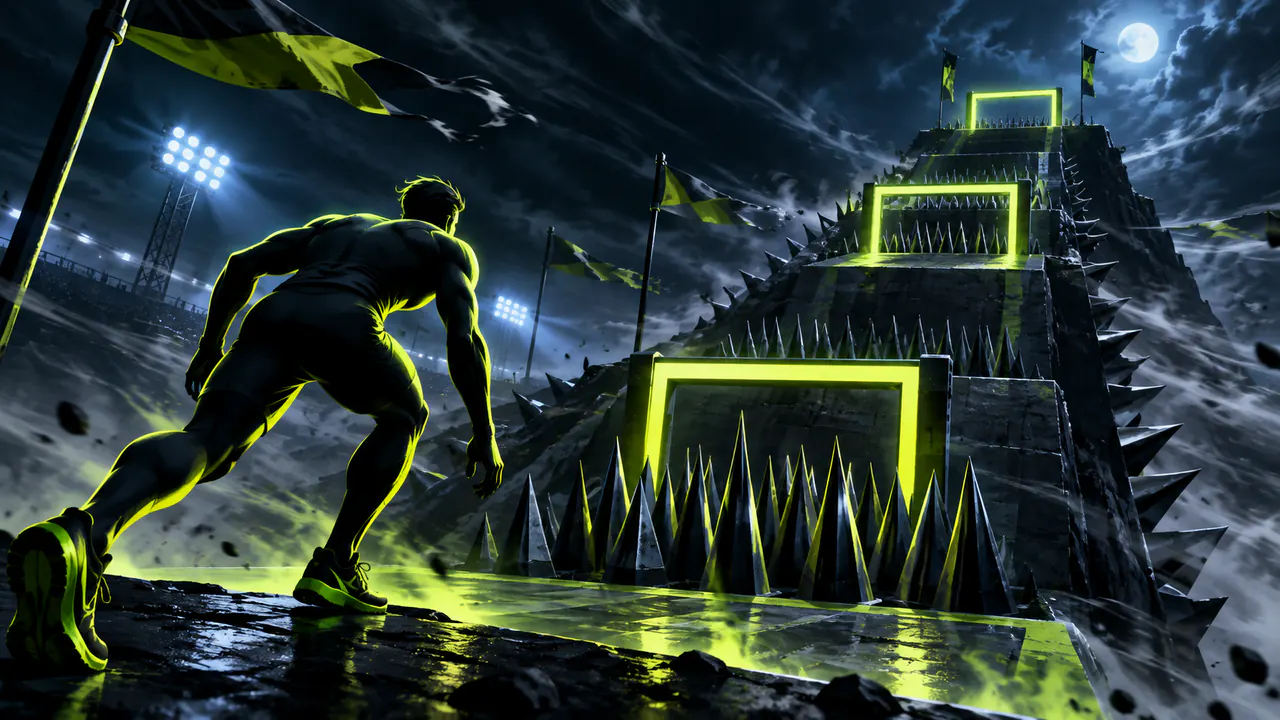
People have argued about the hardest game in history for as long as games have had boasting rights. The argument feels like it should have a winner: one cartridge, one title, one final blow that ends the debate. It does not. “Hardest” is a measurement, and a measurement without a ruler is a shout. This article names the rulers, puts well-known games under them, and then asks what happens when the ruler itself can keep moving — which is the situation an endless score chase creates.
Infinite Game is not campaigning to win the title. The run in the hero is an endless climb, not a claim to be the hardest game ever made. The aim, when the run exists, is a climb you can read. Harder than yesterday is a useful goal. Harder than every game ever made is a marketing sentence that collapses the moment you define your terms.
Name the ruler before you name the winner
At least five different hardships get called difficulty, and they punish different skills.
Execution difficulty asks for precise inputs at speed. A jump with a tight window, a combo that drops if you hesitate, a pattern you can see and still fail. Knowledge difficulty asks you to know a secret the screen will not explain: a weakness, a path, a rule buried in a manual or in folklore. Punishment difficulty is about the cost of a mistake. A long walk back from a checkpoint can make a moderate challenge feel brutal. Luck difficulty is a roll you could not have played better. Endurance difficulty is a test of how long you can keep a standard that, minute by minute, would have been fine.
A game can be extreme on one ruler and gentle on another. A puzzle that took the community months to decode may be easy to perform once you know the trick. A reflex game may be fully knowable and still murderous. When a list of “the hardest games ever” mixes these without saying so, it is a list of famous pains, which is entertaining and not an answer.
There is also a selection problem. The games we call the hardest are usually the ones that found an audience large enough to complain. A forgotten hobbyist game can be harsher and invisible. Fame is not a difficulty setting. It is a reason we have footage.
Execution games, and why they dominate the argument
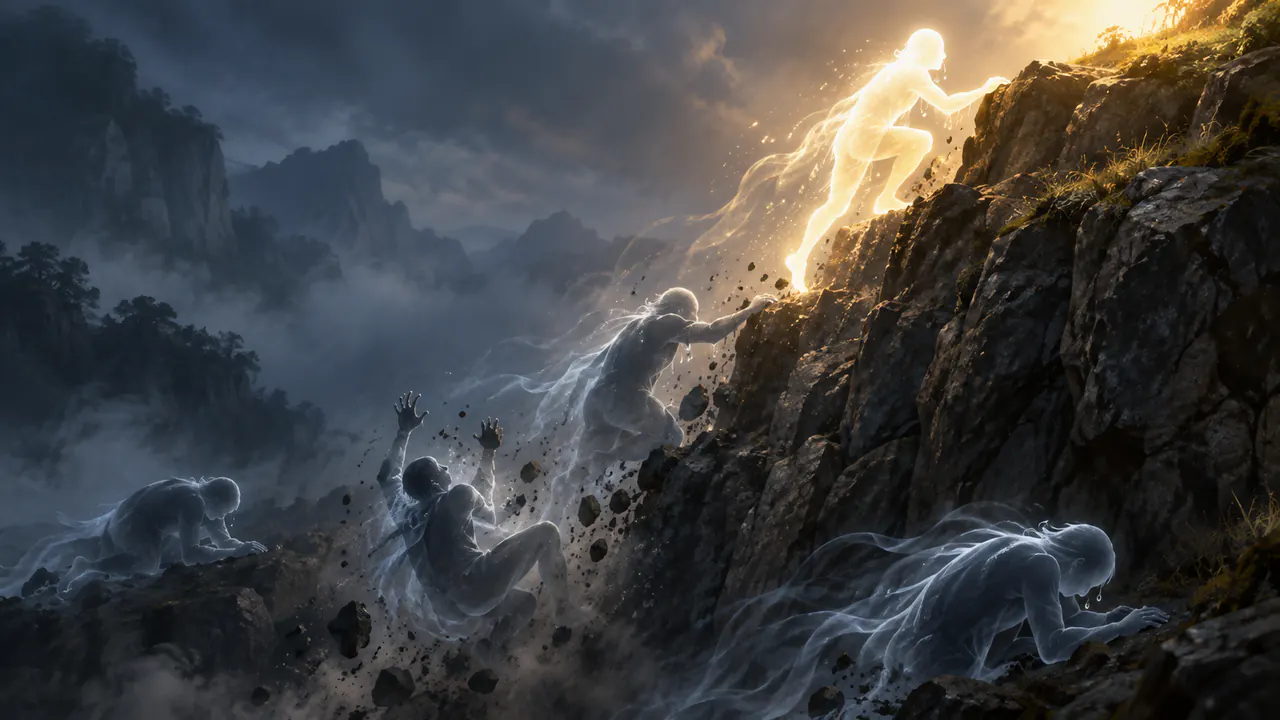
The image is a trial: one figure, several ghosts of earlier failures, an obstacle that does not negotiate. That picture is the folk definition of a hard game. You can see the challenge. You can imagine failing it. You believe, looking at it, that practice would move the result. That belief is the signature of execution difficulty, and it is why platformers and action games own so many of these arguments.
Older console action games are the museum of this ruler. Battletoads is remembered less as a whole adventure than as a few vehicles and tunnels that demand a memorized sequence at a speed the screen barely teaches. Ghosts ’n Goblins sends you back, and then asks you to do the quest again under harsher conditions before it will admit you have finished. Ninja Gaiden, on the Nintendo Entertainment System, pairs agile combat with knockback that turns a small mistake into a fall. None of these is “the” hardest. Each is a clear example of a designer spending the budget on execution and on the price of missing.
Modern skill games often keep the execution and lower the contempt. Super Hexagon asks for pure reading of patterns until the patterns outrun you. Getting Over It with Bennett Foddy makes a single clumsy tool into the whole move set, so failure is frequent and the restart is part of the joke and the pain. Celeste’s hardest optional challenges, especially the golden berries and the late chapter, are execution exams that the main story does not require. They show a useful split: a game can be completable by many people and still contain a summit that only specialists will stand on. Calling the whole game the hardest in history ignores that split. Calling the summit a different sport is more accurate.
Kaizo-style Mario levels and games in the family of I Wanna Be the Guy push the same ruler until the joke and the test trade places. The obstacle is often legible only after you have died to it. Some players adore that contract. It is still a contract, and it should be named: knowledge delivered by death, then execution. If you hate the delivery method, you are not bad at games. You are declining that ruler.
Punishment, knowledge, and the long walk back
A moderate fight becomes legendary if it sits an hour away from the last save. The skill did not change. The cost did. Punishment difficulty is real, and it is often what people are remembering when they say a game “respected” or “wasted” their time. Respect, in this sense, is a checkpoint philosophy. A game that trusts you to retry the interesting five seconds is making a different promise from a game that taxes you with the previous ten minutes.
Knowledge difficulty has its own canon. La-Mulana is loved by people who want a ruin that behaves like a riddle rather than a tour guide. Early computer adventures could be hard because the parser, the map, and the hint were all scarce. Those games are not harder than Super Hexagon in the hands. They are harder in the notebook. A fair comparison says so.
Luck sits in the corner of both. A random critical hit, a shop that did not stock the tool, a procedural room with no safe line: if better play could not have changed the outcome, the loss is not an execution lesson. Roguelikes use luck as a spice on top of a skill they still expect you to have. When the spice becomes the meal, the maximum score stops measuring the player. That problem is discussed from the generator’s side in infinite games autogenerated by AI. Here it is enough to say that luck can masquerade as the hardest thing in the room because it feels personal.
Soulslike games, from Demon’s Souls through the later FromSoftware line, became the popular picture of difficulty in the 2010s. Their combat is strict, their animations are readable once you learn the dialect, and their punishment is usually a run back plus a lost purse of currency. Many, many players finish them. That fact does not make them easy. It makes them a specific contract: learn the move, pay a bounded price, try again. They are a poor answer to “hardest ever” and a strong answer to “hard in a way a large audience agreed to practice.” Sekiro tightens the execution further by centering a single defensive verb. Elden Ring widens the world so you can leave and return. Width is a kindness. It is not a lower skill ceiling. It is a different door into the same family of lessons.
Endurance and the score that never caps
Some of the most extreme play in history is not a last boss. It is a person staying accurate after the game has stopped offering new ideas and has only offered less time. Competitive Tetris, especially on hardware where the speed eventually exceeds what a human can react to piece by piece, turns into a game of setups planned before the piece appears. The killscreen on the Nintendo version is a technical wall as much as a skill wall. Later rule sets move that wall. The cultural memory stays: there is a tempo at which the sport stops being playable in the ordinary sense.
Endless runners and survival score games live on this ruler from the first minute. Flappy Bird’s cultural explosion was an execution game with almost no content budget and a brutal failure condition. The hardest moment was not authored as a unique set piece. It was “the same gap, slightly more costly, again.” Desert Golfing and other quiet endurance toys make the hardship temporal: how long will you keep caring. These are not lesser difficulties. They are difficulties that a campaign game can avoid by ending.

The path in that picture is the shape of an honest curve. It narrows. It does not teleport you into a pit with no approach. Storms are visible before you are inside them. An endless game can follow that shape forever, in theory, by spending its extra minutes on narrower margins rather than on a surprise genre change. The companion piece on whether an infinite game exists explains why “forever” still hits a machine limit. Inside a human session, the curve can pass the point where further progress is a specialty, then a spectacle, then a physical impossibility. That last region is where endless games become harder than any fixed final boss, because the boss can be met and done, and the curve cannot.
Trackmania’s author-medal times, high-level fighting-game execution, and rhythm-game perfects belong in the same family. The content is knowable. The standard is a razor. History’s “hardest” moments on this ruler are often world records, not endings. The game supplies the ruler. The community supplies the number that, for a while, nobody can pass.
Why a single winner would be a worse article
Suppose we picked one title and defended it. We would have to hide the other rulers or declare them unofficial. We would also freeze a moving target. Patches retune bosses. New optional challenges ship. A previously impossible speed becomes possible because someone invented a technique. The hardest game in 1987 and the hardest game in a speedrun spreadsheet from last month are not competing in one category. They are exhibits.
There is a kinder way to keep the question, which is the way this page keeps it. Ask what sort of hard you want. If you want a story that pushes back until you learn its dialect, the soulslike family and its ancestors are the honest neighborhood. If you want a joke that is also a mountain, look at Foddy’s climb and at kaizo tradition. If you want a pattern that outruns your eyes, look at hexagon-hard action and at Tetris at tempo. If you want a record you can hold up without a last chapter, look at endless score chases. None of these neighborhoods is a consolation prize. Each is a different sport that borrowed the word “game.”
Lists that rank them in one column are still fun to read at midnight. They are fan fiction about pain. Use them to find something to play. Do not use them as a measurement.
Fair hard and cheap hard
A second cut matters as much as the ruler. Fair difficulty can be explained after one viewing. You know which hit landed, which input was late, which gap was greed. Cheap difficulty hides the cause: an off-screen threat, a randomized failure, a hitbox that contradicts the drawing, a checkpoint that deletes the learning along with the progress.
Players sometimes defend cheap difficulty as toughness. The defense ages badly, because toughness that cannot be practiced is just weather. Weather can be a mood in a story game. It is a defect in a sport. Infinite Game, if it is going to ask for a maximum score, has to stay on the fair side of this cut even when the curve gets steep. A narrower platform is fair if you saw it narrow. A platform that vanishes because a generator was bored is cheap. The difference will not show up in a thumbnail. It shows up in whether you queue another run.
Difficulty that is fair can still be too steep for the audience you claimed. A first screen that requires a specialist is a choice, and some games wear that choice as their whole identity. A game that invites a general player and then behaves like a specialist exam has made a softer kind of mistake: the invitation was inaccurate. The hero on this site invites you to reach a maximum score. That invitation implies a first minute you can survive by paying attention, and a later minute that will ask for more than attention. The curve picture is that promise. A wall on the opening second would make the rest of the sentence false.
What Infinite Game should refuse
A few refusals keep the project out of a bad contest.
It should refuse to be the hardest game in history as a goal. The goal is a readable endless run whose maximum score means better play under published rules. Some sessions will be hard. Hard is a side effect of a rising curve, not a trophy we have to win against Battletoads or a golden berry.
It should refuse punishment that exists only to waste minutes. If the interesting part is the next ten seconds, the restart should honor that. A long walk is not depth.
It should refuse luck as a substitute for a steeper but still readable margin. Randomness can choose which fair pattern appears. It should not choose whether a pattern is fair.
It should refuse to hide the ruler. When the run exists, the page should be able to say what the score measures and what ends the attempt. Players can then decide if that sport is the hardship they wanted. That is a more respectful offer than a crown.
The live run is part of the refusal. It has no fake final boss standing in for greatness, and it does not pretend the scoreboard is a legend. The articles are here so the words “endless,” “generated,” and “hard” arrive with definitions attached. The game has to survive those definitions without changing them in the patch notes.
A way to answer the question at the table
If someone asks you tonight what the hardest game in history is, you can give them a better reply than a single title, and you can still recommend something before the tea goes cold.
Ask which hardship they mean. If they mean “I want to learn a harsh but readable fight,” hand them a soulslike and tell them the truth: many people finish these, and the learning is the difficulty. If they mean “I want to be humbled by a jump I can see,” hand them a precision platformer or a pattern game and warn them that the summit may be optional or may be the entire product. If they mean “I want a number I can chase without a last chapter,” hand them an endless score game — Tetris if they want a mature sport, a small runner if they want a cruel toy, and this site if they want to watch a new one being built in public.
Then tell them the sentence the argument usually skips. The hardest moment in an endless game is not behind a door you can clear. It is further along a curve that, by design, does not have a final landing. Whether that is appealing depends on the player. It does not depend on a ranking site. The maximum score is the only crown that kind of game can honestly wear, and it is always temporary, which is why people come back tomorrow.