
Guide
Infinite Games Autogenerated by AI
9 min read

An infinite game still needs an author. If nobody is hand-placing the tenth hour, something else has to keep producing legal play. For a long time that something was procedural generation: seeds, noise, grammars, and a programmer who decided what “legal” meant. Generative models now offer a second author, one that has seen many games and can propose layouts, creatures, dialogue, or pictures on demand. The combination is what people mean by infinite games autogenerated by AI. It is powerful, and it is easy to do badly.
This article is the pipeline we would trust before any generated stretch is allowed to change a score on Infinite Game. The play area is already an endless run built from a fixed grammar of chunks. The notes below are the condition for letting a model author those chunks.
Two different machines hide inside the phrase
“AI-generated” gets used for at least two technologies that should not be blurred.
The older one is classical procedural content generation. A seed sets the initial state. A function, often noise or a grammar or a wave-function-style solver, expands that state into terrain, rooms, or item lists. The computer is not remembering other games. It is executing a recipe the designer wrote. Elite did a version of this in 1984 so a universe could fit on a cassette. Spelunky, Minecraft, and No Man’s Sky are later chapters of the same idea: a small description in, a large world out.
The newer one is a generative model. It has been trained on a large set of examples and can continue a pattern it was not given an explicit rule for. A language model can propose a room description or a set of enemy behaviors. An image model can paint a backdrop or a creature. These systems are fluent. Fluency is not the same as a rule that a player can learn, and it is not the same as a layout a character can traverse.
An endless game can use either machine, or both. Infinity, as the companion article on whether an infinite game exists argues, does not come from the model. It comes from a loop that is willing to ask for another legal moment. The model is a supplier. The loop is the game.
What should be generated, and what should stay fixed
A score chase falls apart if the verbs change every minute. The player needs a stable contract: this is how you move, this is how you fail, this is what the number measures. Generation belongs in the material of the run, not in the definition of the sport.
Good candidates for generation:
- The sequence of hazards, inside a library of hazards the player has already been taught.
- The spacing, speed, and combination of those hazards, inside numeric budgets.
- Backgrounds, silhouettes, and incidental creatures that do not change collision.
- Short lines of color text, if the game even wants text, checked so they cannot smuggle new rules.
Bad candidates, especially early:
- New button meanings invented mid-run.
- Collision shapes that do not match the picture.
- Goals that appear without a tutorial beat.
- Difficulty that ignores the last thirty seconds and rolls a spike because the model thought it would be dramatic.
The fixed layer is small and precious. It is the character’s capabilities, the camera, the failure condition, and the score formula. The generated layer is everything that can vary without breaking that contract. When a project reverses those layers — a fuzzy character and a rigid brochure of content — the game stops being learnable. Endless length then amplifies the confusion instead of the skill.
A pipeline with a gate in the middle
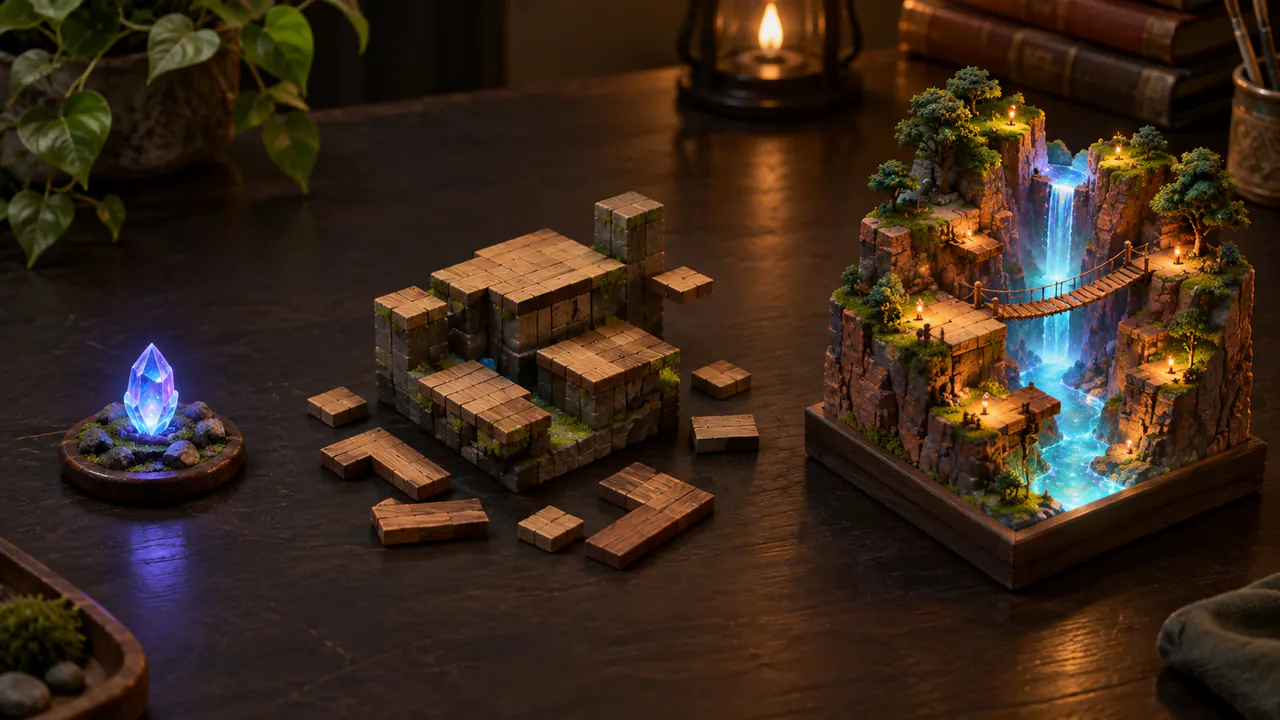
The picture is a diorama on purpose. Generation should look like a workshop with stages, not like a single magic spout.
The first stage is the seed. It is a number, or a short string, recorded beside the score. From the seed the game derives every later choice that is supposed to be replayable. If a model is allowed to be nondeterministic, its output has to be cached with the seed or the run cannot be compared tomorrow. A maximum score that cannot be replayed is a rumor.
The second stage is the grammar. Tiles, beats, or chunks snap together under constraints the designer wrote: maximum jump distance, minimum warning time, how often a new hazard type may be introduced, how wide a safe pocket must be after a dense phrase. This stage can be entirely classical. It does not need a model to be infinite. A modest grammar, sampled for a long time, is already an endless game.
The third stage is where a model may help. It can propose the next chunk, name a biome, or paint the valley the grammar already approved. It can also propose a chunk the grammar then rejects. Rejection is not a failure of the pipeline. Rejection is the pipeline working. The player should never see the rejected pile. They should see a valley that feels authored because something with taste and something with a ruler both touched it.
The finished canyon in the diorama is the only part that enters the hero. Everything to the left of it is backstage. Players do not need to watch the seed crystal. They need the result to be fair when the score is on the line.
Fairness checks before a stretch can score
An unplayable layout is not a hard layout. It is a broken one. Before a generated stretch is allowed to affect the maximum score, a checker should be able to answer yes to a short list.
Can the character reach the next stable surface using the real jump, not an idealized one? Does every lethal thing telegraph for at least the reaction budget of this speed? Is there a path that a skilled player can execute, not merely a path that exists in a graph if you ignore timing? Does the stretch introduce at most a set number of new ideas? Does it contain a recovery pocket so one clipped corner does not always end the run? Are collision and artwork describing the same shapes?
These checks can be code. Some of them can be a second model asked to critique the first, but a critique model is not a proof. Where a number can be measured — gap width, warning frames, overlap of hitboxes — measure it. Use a model for proposals and for flavor. Use arithmetic for the veto.
There is a social version of the same check. If a daily seed is public, players will record deaths and point at frames. That is free quality assurance, and it only works when the stretch is deterministic. An endless game that wants a leaderboard is volunteering for that scrutiny. Build the checker before you build the board.
Variety without lying
Models are tempting because they vary. A grammar alone can start to feel like wallpaper. A model can break the wallpaper: a new silhouette, a new rhythm that still fits the jump table, a valley that does not look like the previous valley. The risk is that the variation lies. A creature that looks like it can be bounced on, but cannot, is a lie. A platform that reads as solid and is not is a lie. A glowing pickup that sometimes scores and sometimes kills, with no rule, is a lie.
The repair is a binding between meaning and form. If the grammar says “safe ground,” the image pass may restyle safe ground but may not move its collision. If the grammar says “telegraphed dart,” the picture must show the telegraph the grammar already timed. Style is free. Semantics are not. This is the opposite of asking an image model to invent the level from a sentence and hoping the hitboxes can be traced afterward. Tracing afterward is how you get beautiful games that feel cursed.
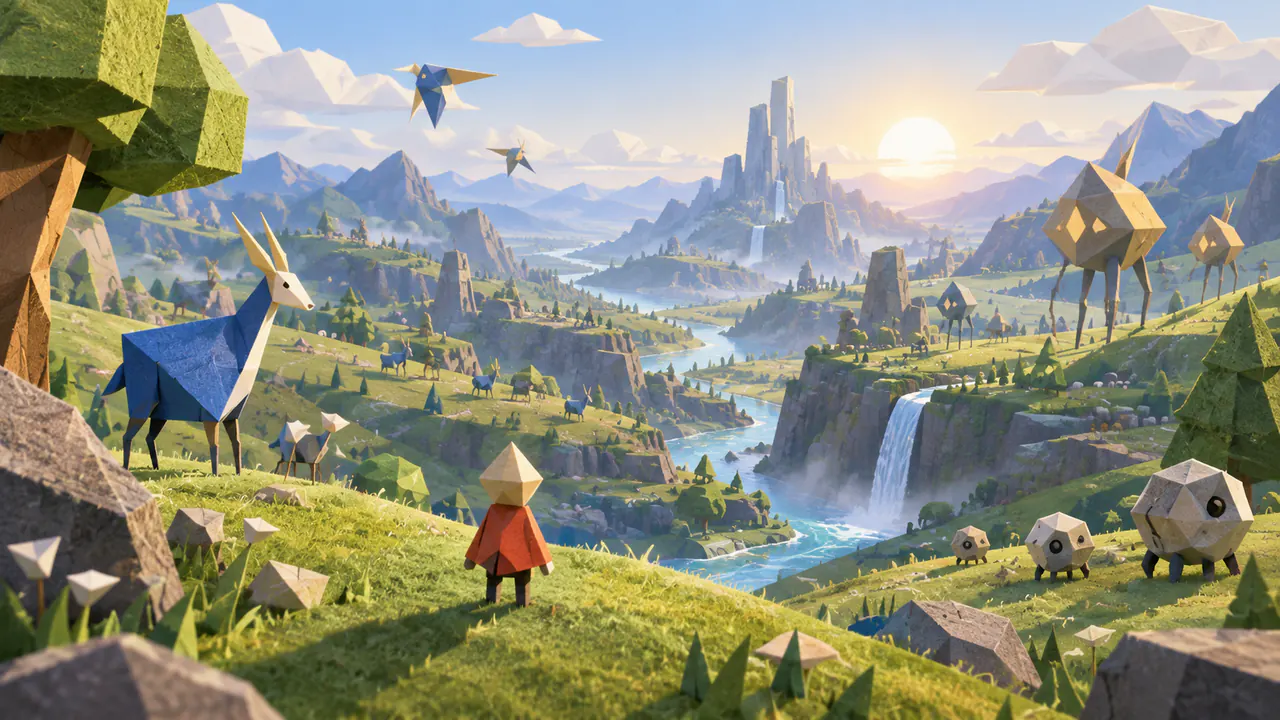
The valley in that image is the target mood: original creatures, one light direction, a figure who is clearly the player and clearly not a borrowed mascot. Nothing in the frame needs to be a famous character to feel like a place you could learn. Coherence is a gameplay feature. When the light, the scale, and the silhouettes agree, the eye spends its budget on timing instead of on decoding the art.
Cost, latency, and where the model is allowed to run
Endless games are loops. Loops that call a large model on every frame will not ship, and they should not. Even a call every few seconds can stall a run that is supposed to feel like a sport. The practical split is between authoring time and play time.
At authoring time, or at the start of a day, a model can propose a catalog of chunks, creatures, and paintings. People or checkers curate them. The live game samples from the catalog using the seed. The player’s machine, or the page, does not have to wait on a network to know whether the next gap is fair. The score stays local and quick.
At play time, a model is optional flavor at most: a line in a quiet moment, a sky that was pre-rendered, a name for a biome that was chosen from a list. If the flavor fails to load, the run continues. A missing sentence must never be a missing platform. The sport is the platform.
This split also controls money and energy. Generating a catalog once and reusing it across thousands of runs is a different bill from generating a private universe per session and throwing it away. An endless game is supposed to be generous to the player. It does not have to be wasteful in the backstage.
Originality and the training-set problem
A model that has seen a lot of games will imitate them. Imitation of a genre — a jump, a scrolling canyon, a rising tempo — is how genres work, and it is fine. Imitation of a specific character, a specific interface, or a specific painted world is how a project becomes a copy. The image briefs for this site already refuse known mascots, readable logos, and lettering. The game should refuse them too.
There is a design reason beside the legal and ethical one. A borrowed silhouette arrives with borrowed expectations. If a creature looks like a character from a game the player already mastered, they will assume that character’s rules. When those rules are absent, the death feels like a cheat. Original shapes are not a style preference. They are how a new game gets to teach its own grammar.
Text has the same problem. A model asked for “flavor” will sometimes emit a famous line, a slur, or a rule that contradicts the fixed layer. Anything player-facing that a model wrote should pass through a filter for length, for disallowed content, and for contradictions with the actual controls. If the filter is unsure, the line is cut. Silence is safer than a wrong instruction in a score run.
What this means for the live run
Infinite Game does not yet let a model autogenerate its run. The hero is an endless score chase built from designed chunks, not from a live model. When generation arrives, it should arrive in the order this article describes: fixed verbs, seed, grammar, proposal, veto, then presentation. The model does not get to skip the veto because its picture was pretty.
If you are comparing this to difficulty, read what the hardest game in history can mean. A generated game can be made arbitrarily harsh by loosening the veto. That is the easiest way to look impressive in a screenshot and the fastest way to lose the players who care about a maximum score. The hard, interesting job is the opposite: keep the veto tight enough that a rising score still means the player got better.
A checklist before any generated minute counts
Use this list as a gate, not as a mood board.
The movement contract is written down and will not change inside a run. The score formula is written down and matches what the player can influence. A seed and a rules version can reproduce a stretch. A grammar, not a raw model dump, decides collision and timing. A checker rejects unreachable gaps, missing telegraphs, and stacked new ideas. Rejected content never reaches the player. Art may restyle an approved chunk and may not redefine it. If the model or the network fails, a preapproved chunk still appears. Nothing player-facing copies a specific existing character or writes a new rule in prose. A human can still explain a death after watching it once.
When every line of that list is true, an AI-authored endless game is just an endless game with a richer workshop. When any line is false, what you have is a demo of a model. Demos can be beautiful. They do not get to hold the maximum score. The run in the hero stays on the designed grammar until a workshop can replace a chunk without lying about either the infinity or the author.