
Guide
Does an Infinite Game Exist?
9 min read
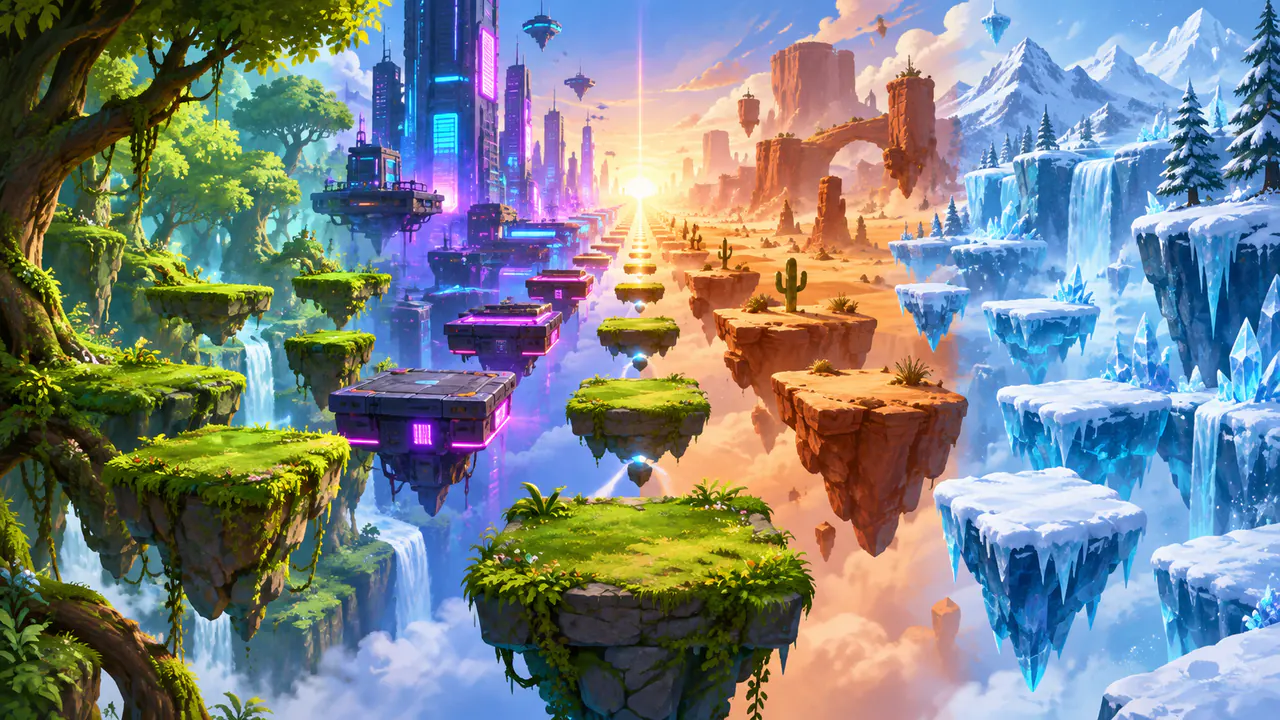
A game can feel endless long before it is infinite. You drop into a run, the next platform arrives, the number in the corner ticks up, and nobody offers you a credits scroll. That feeling is what players mean when they ask whether an infinite game exists. The honest answer has two parts. On real hardware, a video game cannot be infinite in the mathematical sense. In design, a game can refuse to end, and the only finish line left is the maximum score a person can still reach.
Infinite Game is built around that second idea. The run in the hero keeps building past every stretch you clear. This article is the design note underneath it: what “infinite” can mean, which famous games already behave as if they have no last level, and why a score is a better ending than a fake forever.
What players mean by an infinite game
When someone searches for an infinite game, they are rarely asking a set-theory question. They want a game that does not announce that they are done. Sometimes that means a world that keeps generating land past the horizon. Sometimes it means a single screen that will kill you eventually, but will never declare a winner. Sometimes it means a toy, like an incremental counter, that is happy to sit open for months.
Those are three different promises, and mixing them up is how the word becomes advertising. A huge world can still have a border. An endless runner can still end the moment you hit a wall. A counter can still overflow the number type the programmer chose. “Infinite” in a store page usually means “we did not author a final boss.” That is a real design choice. It is not the same thing as a process that can continue without bound.
The useful version of the question is narrower. Does the game contain a terminating state that the designers treat as the end of the story? If the answer is no, the game is endless by intent. If the computer can keep presenting new, legal challenges until the player quits or fails, the game is endless in practice for every session a human will actually play. That is the standard worth using. It respects both the player’s experience and the fact that machines are finite.
A computer cannot store infinity
Every machine that can run a game has a finite amount of memory, a finite clock, and a finite way of writing numbers. A 64-bit integer is enormous. It is not endless. A seed that looks like a universe is a recipe for a very large but countable set of layouts. The moment the recipe, the seed, and the rules are fixed, the set of possible moments is fixed too, even if nobody will live long enough to see them all.
That limit shows up in ordinary places. A world coordinate eventually stops being accurate, or the game installs a border so physics does not fall apart. A score variable wraps around to zero or to a negative number if nobody planned for a long run. A procedural generator repeats when its internal state repeats. None of this is a failure of imagination. It is what it means to compute.
So the strict answer is no: no video game on a real device is infinite. Pretending otherwise makes the design sloppier, not more magical. The interesting work starts after you accept the limit. You decide which finiteness the player is allowed to feel, and which finiteness you hide behind a horizon they will not reach.
Endless is a design choice
An endless game is one that withholds a designed conclusion. There is no last door, no “thanks for playing,” no difficulty that peaks and then congratulates you. The system’s job is to keep offering a next moment that is still a game: readable, bounded by rules, and capable of ending the run when the player misses.
That choice changes what the player is doing. In a finite adventure, progress is a checklist. You remember the region, the key, the boss. In an endless run, progress is a personal record. You remember a stretch of rhythm, a mistake at a certain speed, a score you want back. The game does not need to remember a plot. It needs to remember, or let you remember, the number.
Endless design also changes the author’s job. You cannot hand-place the entire experience. You place a grammar: the legal moves, the legal obstacles, the way risk is allowed to grow. The run is an assembly of that grammar over time. If the grammar is dull, the game becomes a treadmill. If the grammar is unfair, the game becomes a coin flip with a scoreboard taped on. Length does not rescue either problem.
Games people already treat as infinite
Players have accepted “close enough to infinite” for decades, as long as the edge stayed out of sight or the failure felt like theirs.
Worlds grown from a seed
The 1984 space game Elite fit a huge star catalog onto a cassette by generating it from a seed instead of storing every system. Later space games and sandbox builders inherited that trick. Minecraft grows terrain from a seed and, in current versions, places a world border near thirty million blocks from the origin so coordinates and physics stay sane. No Man’s Sky advertised a planet count on the order of 2^64, which is a seed space, not a pile of hand-built planets waiting on disk. In all of these, “infinite” is a way of saying the content budget is a formula.
A seeded world is infinite in the way a coastline is infinite in a painting: you can walk for a long time and still see new shapes. It is finite in the way a recipe is finite. Two players who share the seed share the world. That property is a gift for score chasing, because a shared stretch can be compared. It is also the reason a claim of infinity should stay modest. The catalog is large. The catalog ends.
Runs that only end when you fail
Tetris is the cleanest endless game most people have touched. Pieces fall, lines clear, speed rises, and the game ends when the stack reaches the top. There is no final level in the fantasy of the game, even though some old hardware hits a killscreen when the speed overflows what the machine can display. Modern rule sets can run for a very long time. The ending is still the player’s ceiling, not a cutscene.
Endless runners such as Canabalt, and the mobile games that followed that shape, make the same bargain in a side view. The course continues. The run ends at the first mistake that the speed will not forgive. Roguelikes and roguelites often wrap a similar loop in a meta layer: you lose the dive, you keep a little knowledge or a little currency, you dive again. Hades and Slay the Spire are finite stories told through repeatable attempts. Their combat rooms can feel endless because the authors built a generator with a mood, not because the math goes on forever.
Toys that never ask you to stop
Incremental games, from Cookie Clicker to Universal Paperclips, often have no reflex test at all. The “run” is a curve of numbers, upgrades, and prestige resets. They can be endless because the designer added another layer when the previous layer became trivial. They can also become endless in the bad way: the next hour is the last hour with bigger digits. A score game that wants to stay a game has to keep a decision in the loop. Watching a number is not the same as steering one.
The difference between a curtain and a horizon
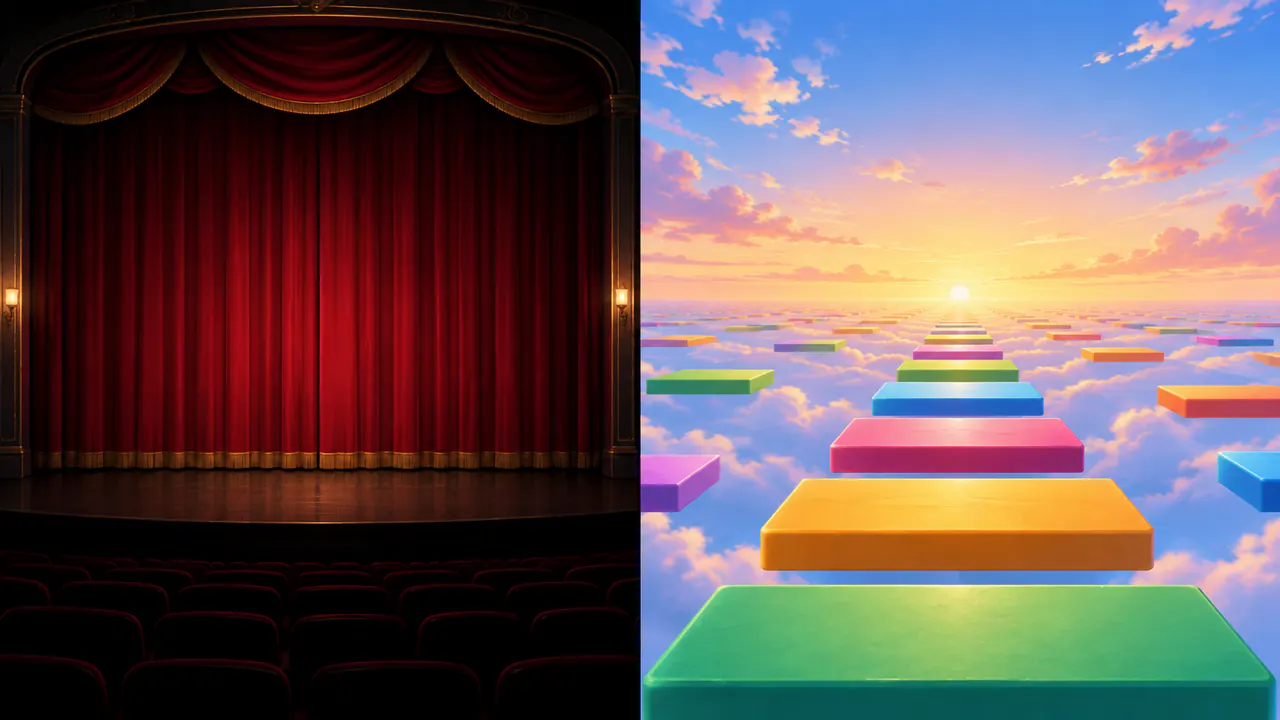
The picture above is the whole argument in one frame. On one side, a curtain: the show is over, the authors have said what they came to say. On the other, a horizon of platforms: the show is a rule that can be applied again. Players love both shapes. A curtain is how a tragedy or a comedy lands. A horizon is how a sport lands. Infinite Game is a sport. It should not pretend to be a three-act plot that forgot its third act.
You can see the same split inside a single hobby. A person may finish a story-rich role-playing game on Saturday and chase a Tetris personal best on Sunday. The first session is about completion. The second is about a ceiling that moves. Asking one game to be both, without admitting which job it is doing right now, is how endless modes get stapled onto campaigns and feel empty. The mode needs its own rules of risk, its own reason to stop, and its own idea of a record.
Why the maximum score is the finish line
If the game will not end itself, the player needs an ending they can choose and compare. The maximum score is that ending. It is local at first: better than your morning run. It becomes social when two people share rules and, ideally, a seed. It stays meaningful only if the path to the number is legible. A random spike that deletes a run at minute twelve does not create a proud record. It creates a grudge.
A good score compresses a run into something you can say out loud. Distance, time survived, lines cleared, dangers passed: the unit does not matter as much as the promise that a higher number required a higher quality of play. If the number can be bought, idled, or rolled, the finish line moves for reasons other than skill, and the endless game turns into a slot machine with extra steps.
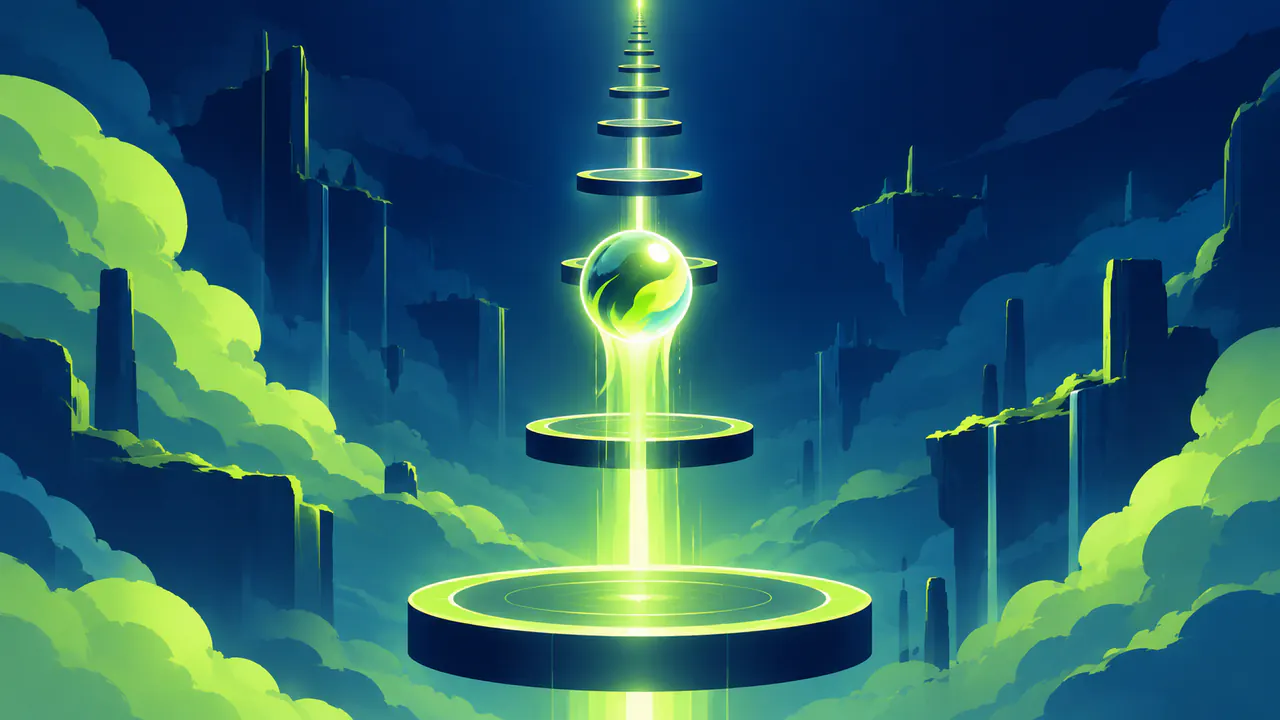
The climb in that image is the mood of the score in the hero. The beam is the score. The shrinking platforms are the cost of staying on it. Nothing on the beam needs a digit painted in the art, because the digit belongs to the interface, where it can be read, copied, and beaten. The art’s job is to make the climb feel like the point.
There is a quiet design rule inside that picture. Early platforms are wide because a first run is a lesson. Later platforms are narrow because a record is a performance. The game never needs a boss named Infinity. It needs the lesson and the performance to be the same rules at two different intensities.
What still limits an endless run
Calling a game endless does not remove the edges. It picks which edges matter.
Memory and the edge of the number
Someone has to decide what the score does at the top of the type that stores it. A practical game picks a ceiling so high that a human session will not hit it, then defines the behavior anyway: stop counting, bank a prestige, or end the run with a clear message. Silent overflow is a bug that masquerades as mystery. Players who care about records will find it, and they will be right to be angry.
The same care applies to the generator’s state. If a run is supposed to be replayable, the seed and the rules version are part of the score’s identity. “I scored 20,000” means little if today’s patch builds a different canyon from the same seed. Endless games that take records seriously publish the version beside the number.
Boredom is a kind of ending
A run can be mechanically alive and emotionally finished. If minute thirty is minute ten with a higher number, the player has already reached the end of the game’s ideas. More speed can delay that, but speed alone is a tax on reaction time. Variety has to change the decisions: new relationships between hazards, new safe rhythms, new ways a greedy line differs from a patient line. The generator should spend its infinity on those differences, not on new colors of the same jump.
Boredom is also a kindness when it arrives honestly. A player who has seen the whole grammar can leave without feeling cheated. The score is on the board. The game did not trap them in a story cutscene to justify another hour. Ending by consent is compatible with a game that has no credits.
Fairness has to survive repetition
In a finite game, an unfair room can be memorized or patched because players will name it. In an endless game, an unfair moment might appear once and never again, which makes it harder to diagnose and easier to excuse as “that’s randomness.” That excuse does not hold. If the generator can emit a jump the character cannot make, or a threat with no telegraph, the game has a defect even if most runs never see it.
The repair is a validator sitting between the idea of a stretch and the stretch the player receives. Reachability, minimum reaction time, and a budget for how much new information one second may contain are not polish. They are the conditions under which an endless game stays a game. The article on infinite games autogenerated by AI goes further into that pipeline. The short version is that generation without a check is a content firehose, and a firehose is not a design.
How this site uses the idea
Infinite Game, the page you are on, separates the claim from the implementation on purpose. The hero says you can play an endless game and reach a maximum score. The run under that sentence does not end at a flag. New stretches are assembled from the same grammar as you move, and the score is the furthest distance you hold.
The run obeys the distinctions in this article. It should end a session when the player fails, not when an author runs out of rooms. It should treat the score as the record. It should keep a seed and a version so that “maximum” means something next week. It should grow risk by tightening a grammar the player has already started to read, rather than by inventing a new verb every minute. And it should be willing to say that the game is endless in design and finite in the machine, because that sentence is the one that keeps the work precise.
If you want the neighboring question — not whether the run can continue, but whether it can become so hard that continuation stops being humanly possible — the piece on the hardest game in history is the pair to this one. Difficulty and infinity are often sold together. They are not the same knob.
A practical test
You can test a claim of infinity without a philosophy department. Ask five questions of whatever is on the screen.
First, is there a credits sequence, a final boss, or a chapter list with a last chapter that the game treats as completion? If yes, it is a finite work, even if it also has a mode that continues. Name the mode separately.
Second, if you play perfectly for longer than the authors played, does a new legal challenge still appear? If the game loops three rooms, you have a loop, not a horizon.
Third, can two players compare the same stretch? A seed, a daily course, or a fully deterministic ruleset makes a maximum score into a shared object. A fresh unknowable layout every time makes the score into a story.
Fourth, what happens at the edge of the number, the coordinate, or the speed? If the answer is “we hope nobody gets there,” the edge is undesigned. Undesigned edges are where endless games embarrass themselves.
Fifth, can you explain a death? If the only explanation is that the generator felt like it, the game has not earned the right to be called difficult, let alone infinite. An endless game is a promise of more game. More game means more of the rules, applied cleanly, for as long as the player and the machine can meet in the middle.
That is the whole standard. An infinite game, in the strict sense, does not exist on the hardware we have. An endless game, with a maximum score as its finish line, does exist whenever a designer builds a grammar that can be repeated without lying to the player. The run in the hero is that grammar, repeated without a last room. The articles under it are the agreement about what we will not pretend.